Astrometry: Simple, Fast, and Seriously Effective!
Astrometry.net: My New Favorite Tool for Astro-Image Solving!
A while back, I penned an article about Elbrus, an astrometry software designed to detect stars in an astro-image and pinpoint the center’s position. Basically, it’s supposed to do astrometry! However, after several tests, Elbrus just wasn’t cutting it for me; it struggled to solve most of my images.
Then, a few days ago, I stumbled upon a free online service: astrometry.net. And voilà – a true revelation! Every single one of my images was identified in mere seconds, complete with a detailed report. I’ve tested it with over a dozen images, and I haven’t encountered a single false positive. All my images were perfectly solved in under 30 seconds, regardless of the field of view or my camera’s orientation. The creators of the service even ran a massive test with over 300,000 images, yielding an impressive 0.1% false positive rate. Here’s a quick test I did on an M101 image:
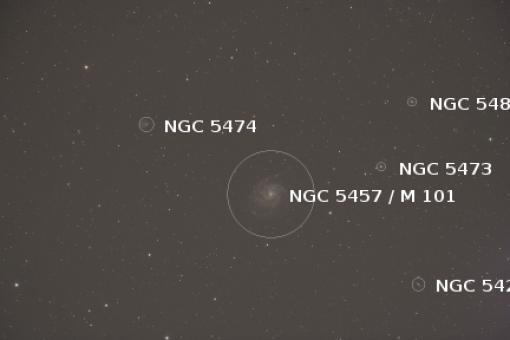
The report for each image is incredibly comprehensive and a joy to read. It not only lists the NGC and Messier objects detected in your photo but also displays your image’s field of view against the entire sky, lets you visualize it in a Google Maps browser, and even overlays the detected stars and identified NGC/Messier objects (in neat circles) directly onto your original image. Plus, it provides super interesting details about your shot: center coordinates, orientation, camera resolution in arcseconds per pixel, the image’s field of view, and much more. Honestly, for me, this has been the discovery of the year!
To give this service a spin, all you need to do is send an email (in English, of course) to [email protected], and they’ll set you up with a free account. I know they’ve also integrated the system with Flickr, but I haven’t had a chance to test that out yet. It’s also possible to download the system’s source code to install on a Linux server. However, unless you don’t have a permanent internet connection or you’re keen to dive deep into the software’s codebase, I highly recommend sticking with the online version; it’s genuinely fast and incredibly simple to use.
UPDATE 12/08/2010: I’m now using MaximDL for my astrometry needs. It delivers fast and precise results, and crucially, it integrates seamlessly into my observatory’s automation process. This is a big win for my workflow!