My First Remote Session: It Works... Mostly!
My First Remote Observatory Session is a Go!
It’s done! I’ve successfully operated my observatory remotely for the first time (from 50m away, over the local network)! This was just a first test, but the results are super promising.
To make everything truly “perfect” and reliable, I still have a few small things to tweak and set up:
-
Add another PC. Honestly, one computer just isn’t cutting it for managing so many USB streams…
-
Be able to perform a remote alignment on one or more stars in case of a crash, or simply to improve GOTO accuracy from one night to the next. My astro-buddy, Jérôme Rudelle, suggested I do what he does: use a modified long-exposure webcam mounted parallel to the main scope. This would give me a wide field of view, kind of like having my eye glued to the finderscope. That’s a solid idea, definitely worth exploring…
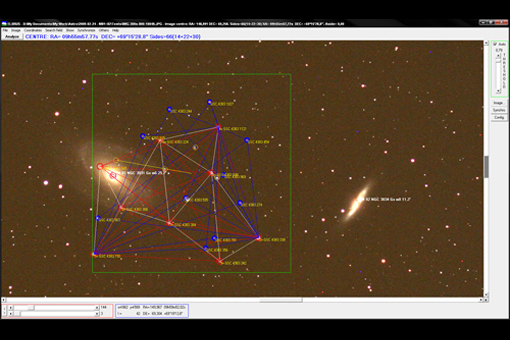
In the meantime, I also stumbled upon a free astrometry solution: Elbrus. This software can analyze an image of the sky with just a few stars and calculate the coordinates of the image center! My initial tests with the software have really impressed me (even with a few hiccups along the way!). It’s genuinely surprising to watch the software work its magic and identify objects in a sky image – I highly recommend checking it out!
Elbrus successfully found the center of one of my images (M81 + M82):
-
Install some weather monitoring tools: A computerized weather station, cloud detector, and/or an All-Sky camera.
So, here’s my remote “first light” shot with the C80ED, guided by Guidemaster and my new PL1M camera on the C11, all riding on the N-EQ6 mount. The focus definitely needs some work; I hadn’t planned on taking photos, just running a few remote tests.
Still, here’s the result: M81 + M82, 1 hour 24 minutes of exposure at 800 ISO, individual frames (subs) of 7 minutes each, with darks and offsets, but no flats.
[](/images/first-remote-control-but-elbrussmall.jpg - M81+M82 - Large.jpg)