Guiding with PHD2: A Deep Dive
Ditching TheSkyX Guiding for PHD2: A Deep Dive
Back in 2008, I was already singing the praises of PHD Guiding. Since then, I’ve experimented with numerous autoguiding software solutions, with varying degrees of success. However, with my recent move to Voyager to automate my imaging sessions, I’ve definitively abandoned autoguiding with TheSkyX in favor of PHD2.
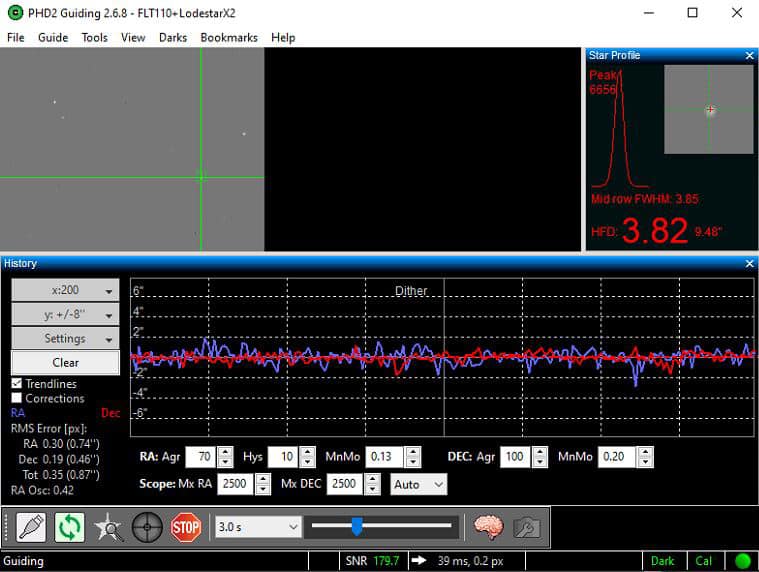
So, why the switch? Because PHD2 focuses on one thing, and it absolutely nails it: autoguiding!
The guiding calibration procedure in TheSkyX is frankly problematic. During a long calibration in a star-rich field, it’s all too common for the software to confuse the calibration star with another one, leading to frustratingly failed calibrations. This happens because TheSkyX doesn’t track the star’s movement in “real-time” during calibration, unlike PHD2. Instead, it selects a star once before the X or Y movement and then tries to “find” it again at the end, sometimes quite randomly… I’ve frequently encountered this issue with TheSkyX on both an EQ8 and an EQ8-R mount, using a Lodestar and a Lodestar X2, with calibration times typically around 20 seconds per axis.
With PHD2, I’ve never had a single calibration problem!