My Adventures (and Misadventures) with the LodeStar
Adventures with the Starlight Xpress LodeStar: Super Sensitive, Super Picky!
It’s been a while since I’ve had proper time for astrophotography! Ever since I got back from Senegal, my free time has been… well, non-existent for deep sky. I did manage to snag some remote images of the lunar eclipse back on June 15, 2011, but since then, it’s been crickets. In my previous post about the Starlight Xpress LodeStar camera, I promised a full review of this little autoguiding powerhouse. A promise made is a promise kept!
Without a doubt, the LodeStar is the most sensitive autoguiding camera I’ve ever had the pleasure (and sometimes frustration) of testing. Its Sony ICX429AL Exview interline CCD sensor truly outperforms every other sensor I’m familiar with in terms of signal-to-noise ratio. I’m running this camera in what I’d call ‘extreme’ conditions: on an Off-Axis Guider (OAG) behind a Celestron C11 scope at F/6.3. And honestly, this camera is genuinely surprising; in every scenario, it’s managed to detect guide stars in under 4 seconds, even with the significant light loss inherent to an OAG setup.
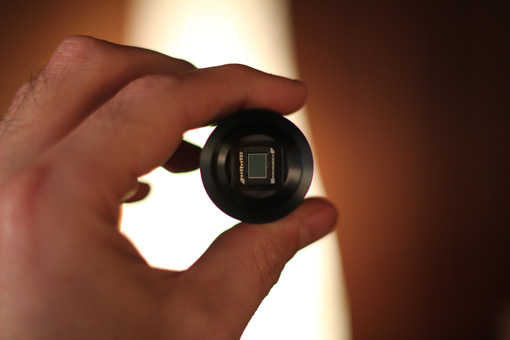
But just having a visible star isn’t always enough to use it as a guide! In an autoguiding feedback loop, it’s not just the camera doing all the work. The autoguiding software plays a huge role too. I’ve been using MaximDL for a while now and, overall, I’m pretty happy with it. However, with the LodeStar, even when a star is clearly visible on screen, MaximDL sometimes struggles to lock onto it and has an annoying tendency to chase noise! Due to a lack of time, I haven’t found a perfect solution to this problem yet, but it’s definitely on my to-do list…
The LodeStar also has a tendency to be quite… capricious. At first, I almost sent it back for service, convinced it was defective. Random oblique lines were appearing across all images acquired with the camera. After some initial tests, I first suspected a USB cabling issue (after all, wouldn’t be the first time USB caused headaches!). So, I went all out and replaced all my USB cables with high-quality, heavily shielded ones with gold-plated connectors. The result? Barely any visible improvement! Next, I suspected the USB hubs. Again, I swapped out both of my hubs for higher-quality models. The result? Still no real improvement!
As I continued my troubleshooting, I finally realized that when I powered the hubs with their original power supplies, all my issues vanished! Eureka! Turns out, the culprit was my lab power supply, which simply wasn’t providing enough current. After replacing that power supply and its cables, I haven’t had a single problem. Interestingly, I used a PL1M camera under the exact same conditions previously and never encountered any issues whatsoever. So, the conclusion? The LodeStar is super sensitive, in every sense of the word!