Right Ascension & Declination: Your Celestial GPS
Demystifying Your Equatorial Mount: RA & Dec, Explained!
I often get asked to explain how an equatorial mount works. Most of the time, folks get a bit stuck on the concepts of Right Ascension and Declination. So, the goal of this article is to try and explain these fundamental (and super important!) astronomy concepts as simply as possible.
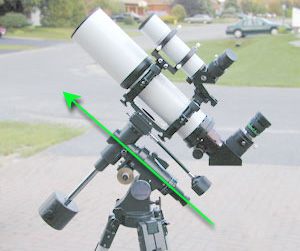
First things first, it’s crucial to understand that an equatorial mount aligns with the celestial north pole (roughly pointed to by Polaris, the North Star). If you imagine a line drawn at a right angle to the counterweight bar, that represents the polar axis – essentially, the Earth’s rotational axis:
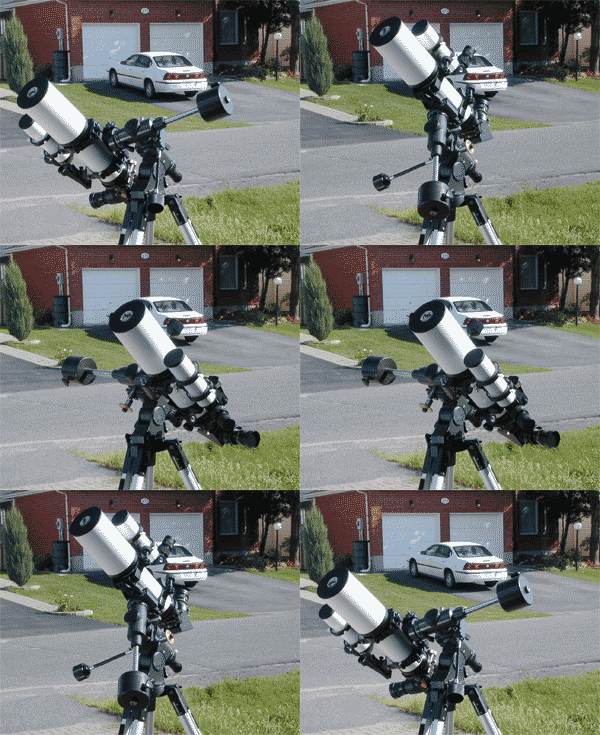
Equatorial mounts can move your telescope in two primary directions. The first is rotation around the polar axis. This movement is called Right Ascension (RA for short):
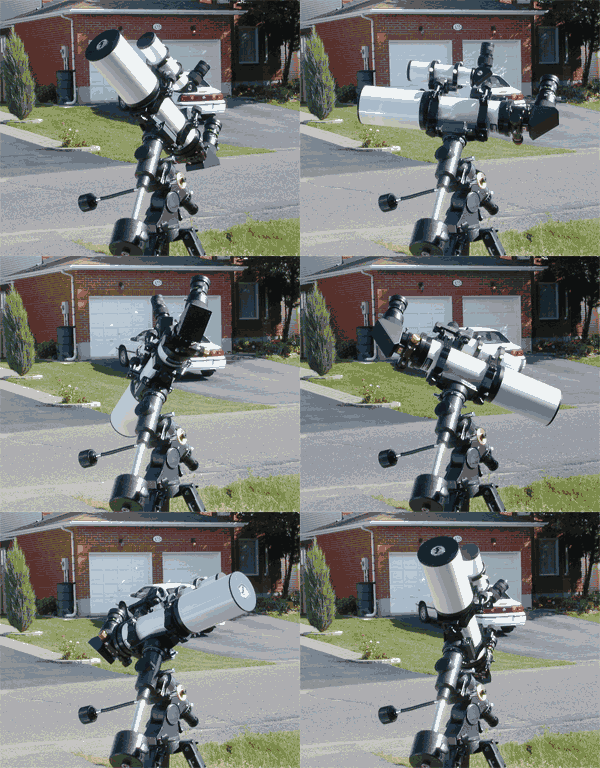
They can also rotate around the axis of the counterweight bar. This movement is called Declination (DEC):
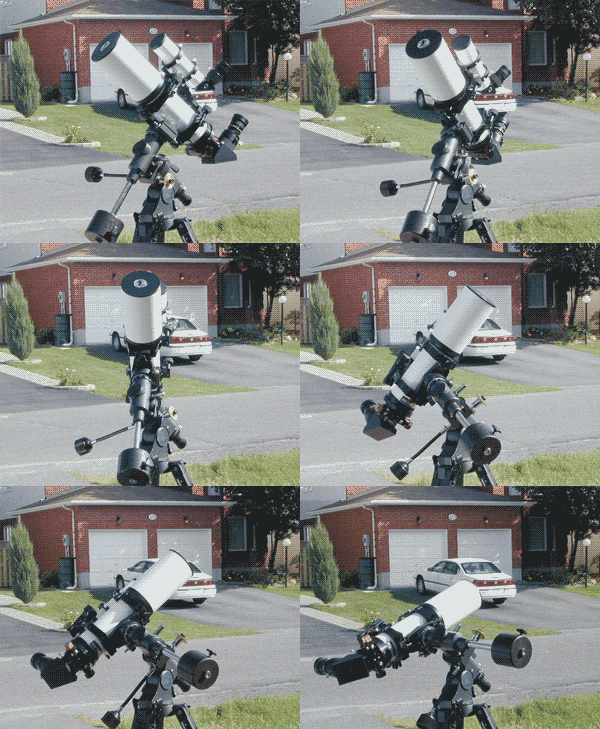
So, in a nutshell: When you move your telescope, if the counterweight bar moves, that’s a Right Ascension movement. If it doesn’t move, that’s a Declination movement!
By combining these two rotational movements (RA and DEC), an equatorial mount can point your telescope to virtually any position in the sky:
Right Ascension is measured in Hours, Minutes, and Seconds. Declination is measured in Degrees, Arc-minutes, and Arc-seconds. Photo Credit: Wikipedia.