Unearthing the Sunstone
Unpacking the Mysteries of the Aztec Sun Stone
If you’re ever in Mexico City, a visit to the National Museum of Anthropology is an absolute must. Among its incredible treasures, you’ll find the Piedra del Sol, or Sun Stone – often, and mistakenly, referred to as the Aztec Calendar. It’s truly one of the most iconic pieces of Aztec art. My interest was immediately piqued because, as is often the case in Mexico, art and astronomy go hand-in-hand.
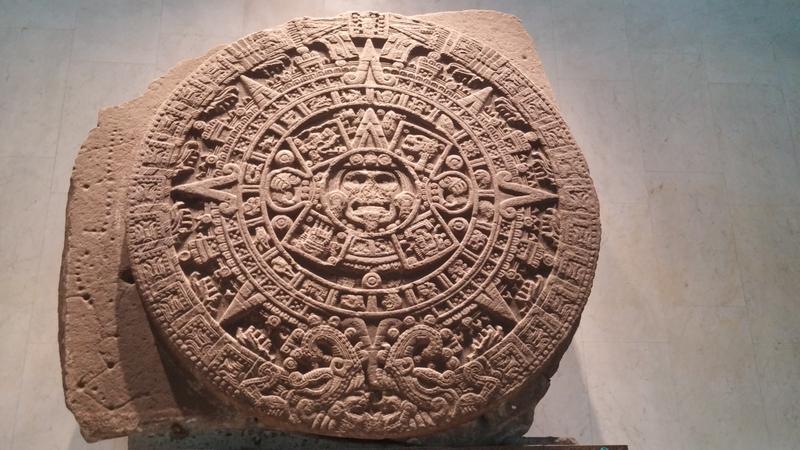
This massive 24-ton basalt block was unearthed in Mexico City in 1790 and most likely served as a sacrificial altar during the reign of Axayacatl. The intricate carvings on its surface tell the story of the Mexica people’s cosmovision – their understanding of the universe. Let’s dive into the seven concentric circles visible on its face:
-
At the Center: The first circle features the head of the Sun God, Tonatiuh. You can spot him by the distinctive curved lines around his eyes and the characteristic jewelry in his depiction. His tongue is represented as a knife, a stark symbol of human sacrifice. The Mexica believed the Sun God demanded this nourishment to continue his journey across the firmament, ensuring he could be reborn each day in the East after his nightly trek through the underworld.
-
The Second Circle: This illustrates the legend of the Suns. For the Mexica, time unfolded in cosmic periods or eras called “Suns.” Before our current Sun, four previous Suns had already passed, and these are depicted in the frames surrounding Tonatiuh’s image. Each was created and ultimately destroyed through the cosmic clashes between the gods Quetzalcoatl and Tezcatlipoca.
-
The Third Circle: This showcases 20 signs representing the Nahua calendar days. The Mexica utilized a 365-day solar calendar, structured with 18 months of 20 days each, plus five “useless” or unlucky days known as nemontemi. The names for these days often referred to animals (serpent, rabbit, monkey…), natural or meteorological elements (wind, rainwater…), plants, objects, or even abstract concepts (death, movement…).
-
The Fourth Circle: This is composed of a series of small frames, each containing a central dot and four elements extending outwards at the corners. This design, known as the “quincunx,” has been interpreted in various ways: as representing the four cardinal points plus the center, as the glyph for Venus, or even as a symbol for precious stones related to fire and the year. This entire circle is edged with a ring of feathers. Following this are other engravings, featuring pointed and trapezoidal elements, topped with a disk. These appear to represent sun rays, jeweled thorn bases, or perhaps the bloodletters used for the daily auto-sacrifice that Mexica priests offered to the Sun.
-
The Fifth and Sixth Circles: These are primarily decorative.
-
The Seventh Circle: This encloses two fantastic, broad-bodied creatures. They sport flames on their backs, tails shaped like sun rays, and rounded, hooked trunks adorned with small engraved circles representing stars. These are known as xiuhcoatl, or “fire serpents.” These mythical beasts are tasked with carrying the Sun across the firmament. Their tails connect with a glyph carved into the upper part of the stone, representing the date “13 Reed.” This could refer to the year this monolith was crafted, corresponding to 1479 CE, or perhaps the mythological date when the Fifth Sun emerged at Teotihuacan.