Voyager: The Smart Way to Automate Your Astrophotography
My Deep Dive into Voyager: Astro Automation Unleashed
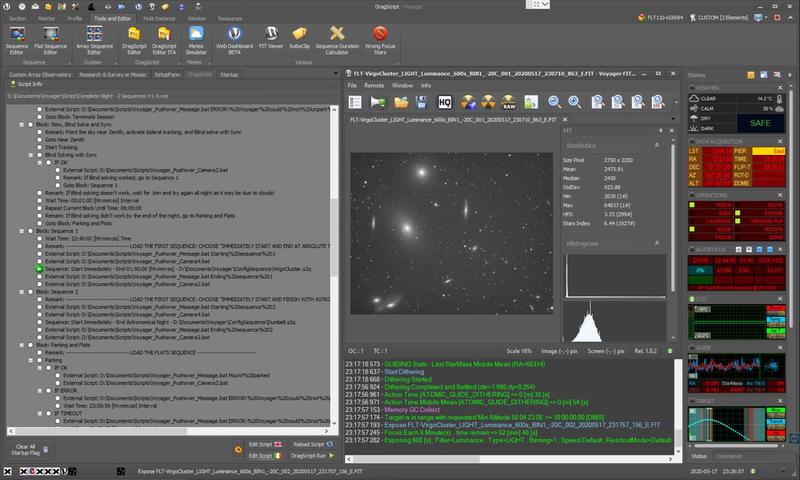
For the past couple of months, I’ve been diving deep into Voyager to completely automate my imaging sessions. In fact, it’s humming along right now, managing both my setups in Ardèche and Mikel’s rig over in Chile!
 ](/images/voyager-automation-voyager.jpg)
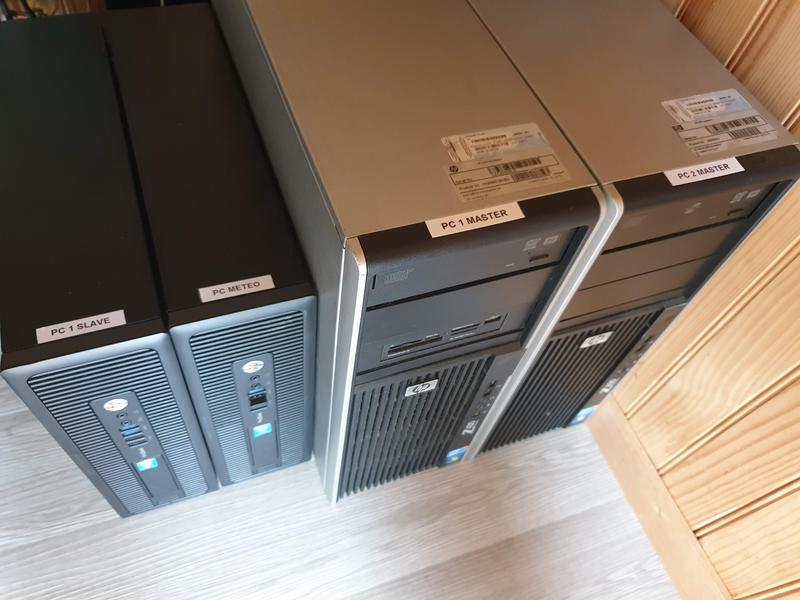
This fantastic software is the brainchild of Leonardo Orazi, an Italian developer who balances his day job in banking applications with his passion for astrophotography. Voyager is highly regarded for its rock-solid stability, its ability to simultaneously manage a cluster of multiple telescopes, and its powerful Dragscript language, which lets you craft incredibly advanced automation routines. Mikel and I were so impressed that we each grabbed a Voyager license. We’re currently running them: one in Chile on Mikel’s setup (an FSQ106 on an EQ8 mount) and the other here in France on my ‘Teenie Galilei’ rig (a Trius H694 on an FLT110 TEC).
 ](/images/voyager-automation-20200606105558-scaled.jpg)
With Dragscript and Voyager’s sequence configuration modules, planning an entire night of imaging is a breeze. The whole show is programmed in advance, and a single click handles everything: observatory roof and weather management, power control, flat panel operations, mobile notifications, and, of course, the imaging itself (think precision pointing, classic or multi-star autofocus, guiding, auto-flats, and more!). Voyager can even orchestrate multiple software applications. For our setups, we have it controlling TheSkyX and PHD2 – a dynamic duo for flawless guiding.
And let me tell you about Leonardo’s email support – it’s absolutely phenomenal. Seriously, it’s not uncommon to get a thoughtful answer to a question at 2 AM! If you’re like us and want to push the boundaries of automated imaging, I can’t recommend Voyager enough!
[embed]https://www.youtube.com/watch?v=VUuhsG5yAuY&feature=emb\_logo\[/embed\]